Article · Operating model & decisions
17 Nov 2026 · English
Leaders ask a transformation to change how the business works while leaving existing authority, incentives and vetoes intact. What must leadership change before the project can deliver?
Article · AI & planning systems
14 Aug 2026 · English
How the board’s AI question can bring a running planning transformation back to its business case.
Article · Operating model & decisions
26 May 2026 · English
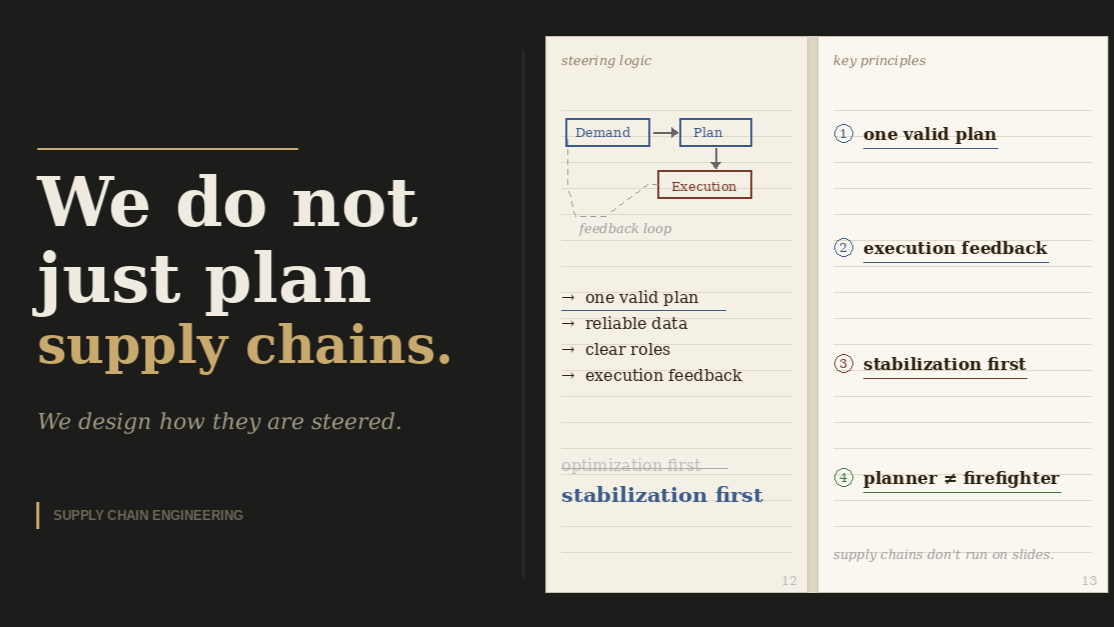
The work of connecting people, planning logic and systems so a supply chain can actually be steered.
Article · Operating model & decisions
19 May 2026 · English
Why S&OP needs decision authority and an agreed way to resolve trade-offs, beyond a meeting cadence.

Article · AI & planning systems
17 Apr 2026 · English
AI gets the attention. Ownership, foundations and execution remain the real problem.
Article · Operating model & decisions
23 Feb 2026 · English
Why escalation still fills the gaps after two decades of S&OP—and what an operating model needs to resolve.
Article · Operating model & decisions
3 Feb 2026 · English
How unclear rules and incomparable site standards turn a production network into an escalation machine.
Article · Operating model & decisions
13 Jan 2026 · English
Why an APS implementation changes the operating model, with consequences for roles, rules and decisions.
Article · Operating model & decisions
2026 · exact date unconfirmed · English · Local edition
Between operating-model design and system implementation sits the question neither side owns: how this supply chain is actually steered.
Article · Operating model & decisions
2026 · exact date unconfirmed · English · Local edition
Why execution feedback closes the order loop while leaving the lead times, lot sizes and capacity assumptions untouched.

Article · People & master data
9 Dec 2025 · English
Master data as the digital form of the operating model: the rules that determine how the supply chain behaves.

Article · AI & planning systems
26 Nov 2025 · German
Warum die Vision selbstheilender Supply Chains ohne neue Regeln, Parameter und Feedback-Schleifen nicht trägt.

Article · AI & planning systems
24 Nov 2025 · English
A look at the distance between AI consulting promises and the decisions a planning organisation actually needs to make.
Article · AI & planning systems
11 Nov 2025 · English
What AI needs from planning logic, data ownership and feedback before it can help a supply chain learn.
Article · Operating model & decisions
4 Nov 2025 · English
Moving the discussion from producing plans to retaining control when execution changes.

Article · From the field
28 Oct 2025 · English
A field observation on ownership gaps, the illusion of autonomy and the people who keep the network running.
Article · People & master data
21 Oct 2025 · English
How planning work changes as knowledge becomes more accessible and orchestration becomes more important.

Article · Operating model & decisions
23 Sep 2025 · English
Connecting planning with execution, stabilised processes and the people who orchestrate the flow.

Article · AI & planning systems
28 Aug 2025 · German
Warum strukturelle Klarheit und ein belastbares Planungsmodell vor dem nächsten APS-Projekt stehen müssen.

Article · People & master data
26 Aug 2025 · German
Warum klare Rollen und gezielter Kompetenzaufbau zur digitalen Transformation der Lieferkette gehören.

Article · AI & planning systems
11 Aug 2025 · English
What holds a network together when the plan breaks—and why it still takes people to do the repair.

Article · People & master data
8 Apr 2025 · English
Why clear roles, planning capability and sustained development belong alongside the digital strategy.

Article · AI & planning systems
1 Apr 2025 · English
Why structural clarity matters more than optimisation power when planning systems fail to stabilise the supply chain.

Article · Stability & buffers
25 Mar 2025 · English
Why planning systems can transmit variability through the network instead of absorbing it.
Article · Operating model & decisions
18 Mar 2025 · English
Why advanced technology still leaves so many people manually repairing supply plans.
Article · Operating model & decisions
11 Mar 2025 · English
Connecting APS, ERP and execution systems into an architecture that carries decisions from the shop floor to the top floor.
Article · Stability & buffers
4 Mar 2025 · English
A framework for combining structural stability with the ability to adapt to disruption.
Article · Stability & buffers
25 Feb 2025 · English
How decoupling and synchronisation work together to protect flow from variability.
Article · Operating model & decisions
18 Feb 2025 · English
Decision support where the plan meets reality: the execution layer and S&OE.
Article · Stability & buffers
11 Feb 2025 · English
Keeping lead times, safety stocks, lot sizes and capacity assumptions aligned with operating reality.
Article · AI & planning systems
4 Feb 2025 · English
Stabilisation as the foundation for reducing variability and creating reliable flow.
Article · Operating model & decisions
28 Jan 2025 · English
S&OE as the control loop connecting planning decisions with changing execution conditions.
Article · Planning foundations
21 Jan 2025 · English
How the end-to-end supply planning argument developed between 2017 and 2025.

Article · From the field
2025 · exact date unconfirmed · English
Why adding agentic AI to fragmented Excel planning leaves the underlying rules and ownership unresolved.
Article · Planning foundations
18 Dec 2017 · English
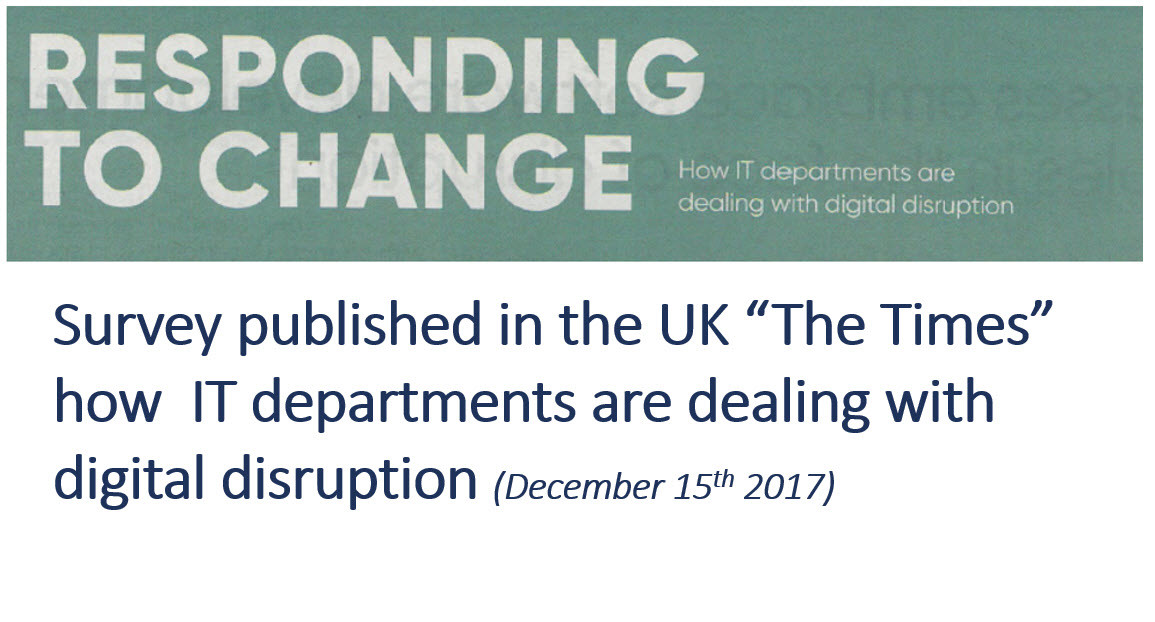
Digital maturity, project methods and the barriers to more responsive IT in pharmaceuticals.
Article · Planning foundations
6 Dec 2017 · English
How planning logic, local priorities and capacity assumptions create inefficiencies along the supply chain.
Article · Planning foundations
29 Nov 2017 · English
Early observations on local silos, MRP-driven variability and the limits of end-to-end planning frameworks.
Article · Planning foundations
22 Nov 2017 · English
The role of forecasts in capability sizing, buffers and end-to-end calibration, including demand-driven planning.
Article · Operating model & decisions
Publication date unconfirmed · English · Editorial edition
Sales promises a delivery date. The plant decides the production sequence. Supply Chain has to deliver the promise. Who can resolve the conflict?
Public LinkedIn link awaiting confirmation.